ECO-SCOPE
Bright/Alice Yard
In hosting Nigerian artist, Ugochukwu Bright Eke, one of the recipients of the Commonwealth Foundation’s, Commonwealth Arts and Crafts Award, Alice Yard in Trinidad and Tobago, was presented with the wonderful opportunity to expand its exploration as a free fluid environment for creative activities, in a range of disciplines.
Through different events such as formal conversation, art installations and gradual accretions to its spatial composition, Alice Yard seeks to play with the creative process, its product and its presentation.
It was created in 2006, as an ongoing project, exploiting the cultural and historical nuances of “The Yard”, in the archetypal urban Caribbean sense. Alice Yard is just that – a typical back yard in the city of Port-of Spain, and so Bright’s presence brought to it the sensibility of a foreign mind, the activity of a foreign creative presence and envisioning from a foreign perspective.
As Alice Yard’s first formal and foreign artist-in-residence, Bright Eke became both collaborator and challenge, in the shaping and testing of the infrastructural and operational accommodations of Alice Yard.
At present, it is a complex of small spaces (band room, courtyard, exhibition/show space, multi-purpose annex and roof terrace), which have provided the setting for intriguing displays in art, design, performance and debate. In its evolution, emerging bands have been showcased, young designers have appropriated the entire complex for their public debut installations and choreographers have countered the clean lines of the glass fronted showing space (Alice Yard Space), with the expressiveness of the human body.
The commentary in Bright’s work also seemed congruent with the physical transformations of Alice Yard, in its utilization of found and discarded materials from its site and elsewhere. This mutation of waste to resource, seemed to parallel Bright’s focus on the environment and the impact of the detritus of mass manufacturing on its condition, with specific reference to water.
In and around Alice Yard, Bright found himself surrounded by collections of recyclable material and objects, of which the plastic water bottle became the material and object of his final show in Trinidad, which he titled “Water and Me”.
Bright/ Alice Yard/ Port-of Spain
It’s 1:00 am and we arrive from the airport, at what will be Bright’s apartment, which is 10 minutes away from Alice yard. As he mounts the pavement carrying his travel bags he turns to me in the darkness of the morning and asks, “Sean, why is it so quiet?” .
I was suddenly confronted then by the quaintness of my island’s city relative to the unimaginable buzz of urban environments which Bright would be used to in Nigeria. Being an architect, I suppose I also understood then, that negotiating this sense of more space in less space was going to underpin how Bright functioned and faltered in his assimilation of Port-of-Spain, both actively and psychologically.
While my fascination with Lagos as an urban phenomenon heightened; stimulated by Bright’s stories of that city’s density of possibilities and difficulties, the reality of Port-of-Spain’s pace/space dynamic challenged Bright’s Nigerian sense of urgency and endeavour; a situation which resulted in his having to invest more of a hands-on involvement in the making of his works, than he either wanted or anticipated.
Additionally, the activity of the band room at Alice Yard at that time, meant that Bright’s introduction to art practice in Trinidad and Tobago was through his being in close midst of persons in music and the performing arts, and so interacting with musicians, singers, dancers and fashion designers was more frequent and likely than meeting fine artists.
These interactions lead more easily to the co-opting of Bright’s work in their productions and so collaborations existed more in the domain of presentation than process.
Bright’s series of painted and distressed umbrellas were used as props and accessories for a fashion show staged at Alice Yard and the presentation of his culminating show “Water and Me” incorporated choreographed dance sequences by the dance troupe ‘Metamorphosis’ under the direction of Sonja Dumas.
Bright/ Alice Yard/ Port-of-Spain/ Beyond
Creative responsiveness has always been invaluable and enjoyable in the staging of events at Alice Yard and so in the days leading up to the showing of “Water and Me” it became more evident that the scale of Bright’s work could not be contained in the Alice Yard.
We investigated in earnest, a site miraculously closer to water, and capitalising on my experience in Carnival, Bright keenly followed through on some of the suggestions for the engineering of his tall but light structure.
This structure, which was central to Bright’s installation “Water and Me”, was a twelve metre tall bottle constructed of hundreds of discarded plastic bottles fastened together. Its mounting was in fact a performance in itself, as lift by lift the looming structure celebrated its lightness and delicacy, rising precariously into the air with Bright eventually trapped within. The resulting towering form had an awesome presence, which was difficult to imagine prior to its mounting, and the slightly discernable silhouette of a human figure occasionally drew attention when it moved within the containment of the bottle’s sparkling envelope.
In its development, sheets of plastic bottles imposed a curvilinear landscape of bulbous plastic within the modest space of Alice Yard. In its final presentation these sheets transformed to a single grand statement in a vast open space off Port-of Spain’s waterfront.
This, Bright’s final statement was for me though unwittingly, encouragement for Alice Yard in spite of its discrete presence, to be instrumental in the shaping of large creative gestures; a conduit for conversations between yard space and world space.
Sean Leonard,
Architect,
Alice Yard,
80 Roberts Street
Port-of Spain,
Trinidad & Tobago
The widespread damage continually inflicted upon the environment and on human cultures in the name of modern progress is coming to a critical point. Accelerating along the trajectory set in place by the Enlightenment, the rise of Western modernism created alienation and the fragmentation of cultures which in turn caused dramatic rifts between people, and between people and nature. Nations, traditions, identities and relationships were shattered into disconnected splinters as a result of modernism’s ascendancy. However, this fragmentation and isolationism is now being countered by a global push towards interconnectivity; the shattered modern world is beginning to reassemble itself into a more complexly integrated and interconnected planet. Despite their many problematic aspects, globalization and communications technology are aiding this backlash against modern alienation. Additionally, social, scientific, spiritual, political, artistic and ecological movements are seeking to repair disconnection and establish constructive interrelationships between cultures, races and genders, and between people and nature. The term ‘interconnectivity’ has become a buzzword in these seemingly disparate subcultures (emphasizing the meaning of the word.)
Working toward interconnectivity with an eye to practical ethical and ecological issues, many contemporary artists are bypassing postmodern issues of the so-called deaths of history, of originality, etc. in order to redress modernism’s blunders. If we pollute our planet to the point of no return, do issues of authorship or pastiche really matter? Philosopher Richard Kearney calls for an ethical and poetic imagination to replace modernism’s exhausted fantasies of individualism and progress, and postmodernism’s empty reflections of cynical surface. Poetic approaches to ethical universal concerns release artists from the traps of modern alienation and postmodern apathy. By stressing the interconnectivity of human action and the environment, artists poetically enact a practical reappraisal of critically fragmented relationships.
Exemplifying this poetic approach to dire global dilemmas, contemporary Nigerian artist Bright Ugochukwu Eke creates installation sculpture from a desire to find commonalities and connections between people, and between people and nature. Eke was born in 1976 in Imo Nigeria and earned a BA and MFA in sculpture from the University of Nigeria in Nsukka. He studied with El Anatsui and gained confidence under his tutelage to experiment with non-traditional materials in his artwork. Eke’s first professional outing was in the 2006 Dakar Biennale of Contemporary African Art in Senegal and subsequently he has been in several international exhibitions and won many awards and residencies around the world. Currently living in Los Angeles, Eke is typical of a new generation of artist who embodies a transnational identity and is concerned with issues that move beyond locality into a global arena of concerns. Eke uses a poetic approach to the critical ethical problems of environmental destruction and the disconnection between humans and nature that allow for ecological devastation.
With a strong sense of an underlying interconnectedness linking all life forms, Eke calls attention to the harmful man-made boundaries that cause disconnection and destruction. Eke proclaims, “Having perceived this interconnectedness and interdependence of humans and nature, and having felt the damage, the separateness, and barriers we have created selfishly and egoistically, I thought it pertinent to find ways through which we could ameliorate or proffer some solutions to some of these… I thought of a common language in nature. That brought me to the language of WATER!” Eke uses water as both a material and a metaphor to speak eloquently about universal human and environmental problems. Eke explains, “Water is a universal medium. It’s common to everybody, no matter who or where you are. Whatever I do with water is what every other person does with it in every part of the world. The most interesting part is that we are bound or connected by [water.]” This connection has been ignored and abused, and as a result, water has become critically damaged by the industrial processes of modernism. Eke’s work foregrounds this issue of alienation between humans and nature.
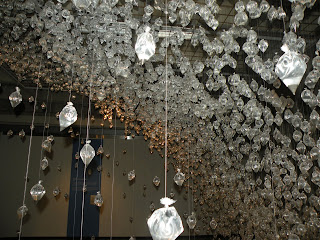
Created for the 2006 Dakar Biennale of Contemporary African Art in Senegal, Eke’s installation Acid Rain comes from his direct contact with toxic rainfall. While working in Nigeria’s gravely polluted Port Harcourt, Eke developed a skin irritation due to acid rain from local industrial pollution. This incident inspired enquiry into the causes of acid rain and his resulting artwork illuminates this problem. Eke’s piece is an assemblage of small plastic bags containing water fouled with battery acid that are bound and hung from string at different lengths. A 2008 rendition of this work, Water Drop, is also a cluster of polluted water packets, each resembling (acid)raindrops, forming a larger shape of a water droplet, emulating water’s ability to be multiple units yet part of a unified body. In this allusion to the concept of interconnectivity, the fluid multiplicity of water serves as a metaphor for individual humans making a cohesive, although perhaps dysfunctional, society. Similarly, the individual affects the whole - individual consumption of the products of industry, namely oil and consumer goods, drives the toxic processes that create wide-scale environmental damage. The connection and interdependence between human action and the environment is frequently ignored and disrespected; by suggesting the fluid nature of the dichotomy of the individual and the whole, Acid Rain and Water Drop call attention to a global problem we all participate in and are effected by, consciously or not.
Water Drop 2008, Bright Ugochukwu Eke
In Eke’s installations, we are initially drawn in by the visual beauty and meticulous process of construction; thus engaged, we become aware of the serious content embedded in the work. Eke explores the theme of (dis)connection further in his spectacular large-scale installations Natural Connection, created for the 2008 International Festival for the Arts in the Netherlands, and Confluence, made for the 2008 international exhibition CodeShare in Lithuania. In both of these works, hundreds of clear plastic water bottles were painstakingly connected into dazzling, sinuous mazes that viewers can interact with and walk through. These installations are “an attempt to create a common ground for interactions between people” Eke states, as they struggle to move through the narrow ‘waterways.’ Although officially part of international art events, these pieces were exhibited in everyday environments like a shopping mall and a local neighborhood street, not just in the privileged spaces of gallery and museum. In these unconventional spaces, the artwork is available to everybody, connecting the work and its meanings to everyday life. Additionally, the water bottles used in these pieces were culled from the surrounding areas of the installation sites; this attention to connection with the artworks’ environments is very much a part of Eke’s message. Eke explains, “My medium/work is from the environment, about the environment; from the public, about the public and everyday life - from the society/culture and about the society/culture.” Regrettably, plastic water bottles have become an everyday aspect of our daily life and environment.
The ubiquitous plastic water bottle is a contemporary symbol of the increasing problems of acquiring drinkable water and is arguably the quintessential icon for the disconnection between people and nature. In many parts of the world the water supply is dwindling and much of it is contaminated by industrial waste or by lack of appropriate sanitation, forcing many people to resort to importing water in plastic bottles. Whether merely trendy items of convenience or tools temporarily fulfilling a genuine need, plastic water bottles are not a sustainable solution for portable water; rather, plastic water bottles create further environmental problems. Made from petrochemicals in toxic processes, plastic water bottles contribute to pollution in their production and international transport, and add to the political shenanigans surrounding oil. Furthermore, plastic is not biodegradable and water bottles are rapidly littering our environment, harming wildlife, releasing toxic fumes in their incineration and filling our garbage dumps. There is also concern about the safety of drinking water bottled in plastic due to chemical leaching. Eke’s choice of plastic water bottles as a medium to signify the drastic disconnection between humans and nature is an eloquent and effective one.
Natural Connection 2008, Bright Ugochukwu Eke
Besides the water bottles being potent indicators of the disconnection between humans and the environment, the meandering walls of Natural Connection and Confluence are also symbolic of the ideological walls people erect to separate each other from diverse cultures, races and genders, as well as from the natural world. Assigning Otherness to an individual, a group, or to nature, sets up an alienating opposition; Eke’s work highlights and attempts to dissolve the barriers separating people and cultivates awareness of the interconnectivity of life. Eke chooses to collaborate on the construction of his works with people from the local installation area and considers this cooperation a vital aspect of his work. Joining forces with a variety of people emphasizes the content of Eke’s work; Eke states, “Working with people has always been something I like to do because of the nature of my work… I also like to feel the connection with other people in my work. My idea is about the connection with people, the societies/cultures, and the environment. How one affects the other. So I will not feel fulfilled even when I can do the work all alone.” Eke’s art-making process works toward building connections with diverse communities which facilitates breaking down the barriers between people and dissolves the alienating classification of Otherness.
Natural Connection 2008, Bright Ugochukwu Eke
Pushing beyond the assigned identity of the Other, many third generation post-colonial African artists, like Eke, are less concerned with constructing and projecting a specific and recognizable African identity than African artists in the first decades of independence. Negritude and Pan-Africanism expressed the backlash against colonial imperialism and embodied the search for a new cohesive African identity. Artists of this dynamic era played a major role in constructing this new identity, often under strong social and political coercion. New hybrid identities acknowledging and embodying multiple cultural influences became the new social paradigm in Africa, and around the world. As professor, writer and critic Okwui Enwezor points out, the identities of Africa are a construction of the “collision of Africa and Europe” which have created the heterogeneous positions in African contemporary identity. Enwezor confirms “all forms of culture and identity are constructed, shaped and reshaped by varying forms of historical conjunctions, appropriations, contestations and refusals.” Cultures have always borrowed from each other, now more than ever in this age of globalization and interconnectivity. The current generation of African artists is expressing a transnational or global identity that is moving beyond locality and hybridity, and emphasizes the interconnectedness of cultures. Eke is one of these transnational artists explaining, “I am an artist from Africa but in a global society.”
Confluence, 2008 Bright Ugochukwu Eke
Although Africa is now technically post-colonial and participating in a global world from a freer political stance, many Western writers, anthropologists, scholars, art historians and art collectors continue to contrive to assert their imperialist notions in regards to African art. The voyeuristic pleasure of creating an African Other isolated in a ‘primitive’ and exotic past has compelled some Westerners to continue to select, promote and support a narrow range of African art – art that professor and critic Nkiru Nzegwu claims “must be outside Africa’s own modernity [and] is...relocated outside of time and history.” A large part of the West’s need to dismiss and marginalize contemporary African artists is played out in a self-serving narrative constructed for the African Other by the West surrounding ideas of authenticity. The drive to label certain African artwork as ‘authentic’ is an extension of the attempt to contain and dominate African artists and maintain notions of Western superiority.
The West often chooses African aesthetic forms that satisfy a Western-constructed African identity that is assumed to be disconnected from Western influences; African art that can be linked to Western practice is often disqualified as ‘inauthentic’. If ‘inauthentic’ contemporary African art merely mimics Western art, that sets up the logic confirming that Western art is the superior origin; the West is confirmed as the source of originality and authentic genius and ostensibly only the West can assimilate other cultures’ aesthetics without losing its identity. This is an imperialist belief that allows the West to impertinently graze the world’s cultures for its own usage and to mask its own empty cultural concoction. Artist, professor and critic Olu Oguibe contends that the West needs to create the identity of the inauthentic, or the simply Other, African in order to “not reveal itself as mimic, as a culture of quotations, as a mediated translation of cultures and art traditions other than itself, as pastiche.”
These issues surrounding authenticity are also another means of isolating and separating people and cultures; the isolationist stance of the West denies the interconnectivity of culture. However, as the world moves inexorably beyond modernist notions of simplistic binaries and isolationism, and beyond postmodern ideas of hybridity and pastiche, the concept of authenticity versus inauthenticity collapses. The acceleration of interconnectivity and complex interchanges between cultures nullifies these outmoded methods of alienating classification. Eke does not play into the Western demand for African exoticism and ‘proof’ of authenticity; his artwork comes from his direct experience of the world around him: “My materials and the issues I try to address are found both in Africa and globally.” Eke’s work seeks to examine and repair the disconnection between cultures and move beyond the limitations of imposed Western narratives.
Bright Ugochukwu Eke’s installations illuminate the connections (and disconnections) between people and their environment, which mirrors the (dis)connections between people and cultures. Through evoking issues surrounding water, Eke uses a poetic approach to the critical ethical problems of environmental destruction caused by the disconnection between people and nature. Eke sums up his artistic intention declaring, “I am interested in exploring water in ways that can examine global human and environmental issues.” Seeking commonalities and stressing the interconnectivity between people, Eke is part of a new generation of transnational artist concerned with global dilemmas that transcend specific identity and locality. The fluid multiplicity of meanings in Eke’s work is artfully expressed in his chosen medium: the universal and unifying element of water.
PAGE \* MERGEFORMAT 5
Notes
Richard Kearney, HYPERLINK "http://en.wikipedia.org/w/index.php?title=The_Wake_of_Imagination&action=edit&redlink=1" \o "The Wake of Imagination (page does not exist)" The Wake of Imagination. (Minneapolis: University of Minnesota Press, 1988), pp.s 361, 367.
Bright Ugochukwu Eke, Eco-Scope Blog. http://u-bright.blogspot.com/.
Bright Ugochukwu Eke, Written email interview by Celeyce Matthews. (California, April 25, 2009).
Ibid.
Ibid.
David Grossman,“Breaking the Bottled Water Habit.” USAToday.com. (September 22, 2009). http://www.usatoday.com/travel/columnist/grossman/2008-09-19-bottled-water_N.htm.
Deborah Kotz, “The Study of Chemical in Plastic Bottles Raises Alarm.” US News and World Report. (April 16, 2008). HYPERLINK "http://health.usnews.com/articles/health/living-well-" http://health.usnews.com/articles/health/living-well-usn/2008/04/16/study-of-chemical-in-plastic-bottles-raises-alarm.html.
Eke, interview by Celeyce Matthews.
Enwezor, Okwui. “HYPERLINK "http://vrc-collections.sjsu.edu/courses/275/Modern%20Africa/Tricking%20the%20Mind.pdf"Tricking the Mind. The Work of Yinka Shonibare.” Authentic/Ex- Centric: Conceptualism in Contemporary African Art. Ed.s Salah Hassan and Olu Oguibe.(Ithica, NY: Forum for African Arts, 2002), p. 217.
Ibid.
Eke, interview by Celeyce Matthews.
Nkiru Nzegwu, “Introduction – Contemporary African Art and Exclusionary Politics.” Issues Contemporary African Art. (Binghamton, NY: International Society for the Study ofAfrica ISSA at Binghamton University, 1998), p. 11.
Olu Oguibe, The Culture Game. (Minneapolis: University of Minnesota Press, 2004), p 7.
Eke, interview by Celeyce Matthews.
Natural Connection was produced at the International Festival of the Arts in Arnhem-Netherlands under the theme: Art, Migration and Identity. It focuses on issue of the common ground for all cultures/races with reference to movement which is usually constrained among these. As i have always said, water unites every body even with the environment. It does not recognize any boundaries and moves freely. These are walls of water bottles; they remind me of the cultural, racial, and gender barriers, and differences we have created for ourselves. The plastic bottles are not environmentally friendly, and therefore reminds me of the barrier with the environment. It is made to be experienced hence, it is interactive. It was exhibited in alternative spaces(not in gallery or museum), like shopping mall and a space in a neighborhood of immigrants who are disconnected from the Dutch indigenous society of Arnhem.